From Prompt Book to Shared Rehearsal Record
A shared rehearsal record keeps agreed choices visible as a production changes, helping each department stay aligned without replacing discussion in the room.
The common mistake with a prompt book is treating it as a private store of instructions: one person records what happened, then expects everyone else to follow it. A shared rehearsal record works better when agreed choices are easy to find and question. It can help prevent a lighting cue, costume detail or entrance pattern from drifting unnoticed, but it cannot make decisions for the people in the room.
Choose a record that matches the work
A prompt book is the stage manager’s working copy of the script, often marked with cues, entrances, blocking and notes needed to run a performance. A shared rehearsal record is broader. It may include the current prompt book alongside a decision log, rehearsal reports, scene notes and department updates. Its purpose is to preserve what the company has agreed, not to document every thought spoken aloud.
Start by asking what is currently being lost. If actors repeatedly ask where a scene begins, record the agreed starting point. If the director and designer are still exploring alternatives, mark an idea as provisional rather than writing it as a settled instruction. The record should show the status of a choice as clearly as the choice itself.
Keep the record practical. A printed script with pencil marks may be the clearest source for cue placement; a shared document may suit decisions that affect several departments. Avoid maintaining parallel versions unless someone is responsible for reconciling them. Anyone who needs the record should be able to identify the authoritative copy.
Match the format to the rehearsal situation
When the staging changes from session to session
Use a dated rehearsal log and label blocking as provisional. This suits early exploration, when a scene may be tried in several arrangements and a fixed prompt book could make experiments look final. Record the question being explored and what the company wants to revisit.
When several departments need the same decision
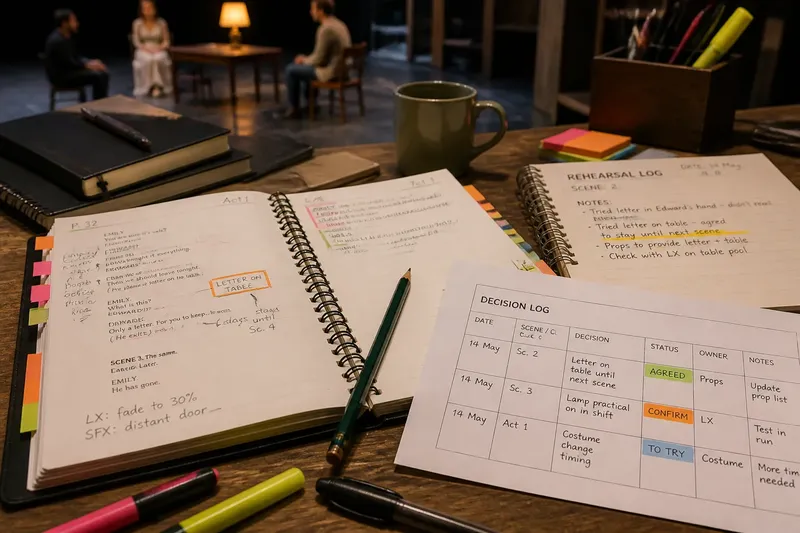
Keep a shared decision log with a short entry for the choice, its status, the person responsible for passing it on and the relevant scene or cue. This suits decisions such as whether a hand-held object is present throughout a scene, because props, direction and costume may all need the same information.
When the production is close to performance
Use a clean, current prompt book as the operational record, supported by concise updates for changes made in rehearsal. This suits a run in which cue timing and traffic need to be repeatable. Keep exploratory discussion elsewhere so the person calling the show can find the active instruction quickly.
Give each note a clear status and owner
Useful records distinguish among a proposal, an agreed choice and a change that still needs checking. Simple labels such as “to try”, “agreed” and “confirm” are often enough. Add the date and the location in the script or rehearsal room where the note applies; “move later” is hard to use if nobody knows which entrance or scene it refers to.
Assign ownership by task, not by assumption. The stage manager may maintain the prompt book, while the director confirms staging choices and department leads update their own working materials. A note can name who will communicate a decision without implying that one person owns the creative choice.
Say you are rehearsing a scene in which a character leaves a letter on a table. The company first tries the letter in the actor’s hand, then agrees that it should remain on the table until the next scene. Mark the table placement as agreed, note the scene transition where it matters, and identify props as the department to update. If the director later reopens the choice, change its status rather than leaving both instructions active.
Keep the record useful without making it the rehearsal
A short record made soon after a session is usually more helpful than a long transcript. Capture decisions, unresolved questions, changes that affect other people and tasks that need follow-up. Leave out comments that do not guide the next session or preserve a choice the company has made.
- Check that the note names the relevant scene, cue or rehearsal date; if it does, keep it in the active record, but if it does not, add that reference before sharing it.
- Check whether the point is proposed, agreed or awaiting confirmation; if its status is clear, leave it active, but if it is unclear, confirm the status with the relevant decision-maker before treating it as an instruction.
- Check that the action is observable, such as “crosses to the desk before the line”; if someone can follow it, retain the wording, but if it is vague, ask for a concrete action or leave it marked for discussion.
- Check whether the people or departments affected are named; if they are, send the update to them, but if they are not, identify who needs it before closing the note.
- Check whether an older instruction has been superseded; if it has, remove it from the active copy and retain it in an archive only if useful, but if it remains current, keep it visible.
- Check whether the company has had a chance to correct the note; if it matches the agreed choice, keep it, but if it misrepresents the discussion, amend it with the people concerned.
It is not worth recording every variation an actor tries, every passing suggestion or every line reading. Excess detail hides the choices that matter and can make a flexible performance feel policed. The record should support memory and coordination, not turn rehearsal into paperwork.
Handle changes as part of the process
Rehearsal choices evolve. A note that suited a scene in a bare room may need adjustment once furniture, costumes or technical cues enter. Treat the record as a current account, not a permanent verdict: update the active instruction, retain context where useful and make clear what has been replaced.
When a change affects several people, communicate it in the room as well as in the document. A quiet update to a shared file may not reach an actor working from a printed script or a technician preparing a cue sheet. Use the record to confirm the conversation, not to replace it.
What should a rehearsal record include?
Should every blocking choice go in the prompt book?
Record stable movement that affects entrances, cues, safety or continuity. Leave temporary experiments marked as provisional, so a trial is not mistaken for a settled direction.
Who should maintain the shared record?
Choose one person to keep the master copy orderly, usually the stage manager or another agreed production role. The director and department leads still confirm the decisions that belong to their work.
How do you stop two versions from conflicting?
State which copy is current and date changes when they are made. If printed notes remain in use, tell their readers which updates they must transfer before the next rehearsal or performance.
When should a note be removed?
Remove or clearly supersede a note when the company has replaced it and the old instruction could cause confusion. Keep an archive only when the production has a practical reason to retain the history.
Let the record serve the people in the room
A prompt book and shared rehearsal record are most useful when they reduce avoidable uncertainty: what has been agreed, where it applies and who needs to know. Their accuracy depends on people checking the wording together, especially when a change affects another department. For a production refining its rehearsal record, ask whether a colleague can tell what to do next without mistaking an experiment for a decision.
Keep that question in view, and the record can preserve continuity while leaving room for actors, director and designers to respond to what happens live. Where a production’s own procedures or venue requirements govern record-keeping, follow those instructions. The page should make collaboration easier to resume, not claim that collaboration is finished.