The Myth of the Natural Voice on Stage
Natural-sounding acting is not one correct vocal style. Learn to shape clarity and intention so speech feels alive without losing the audience.

The most common mistake in natural-sounding acting is to treat everyday speech as the standard: keep the voice small, blur the ends of words and avoid anything that sounds deliberate. On stage, that choice can cost the audience the line, the thought behind it and the changing relationship between characters. A natural voice on stage is not a voice without technique; it is a voice whose choices feel connected to the moment.
Actors and directors use “natural” to mean several different things. They may mean conversational, emotionally credible, free from declamation, or suited to a particular character and setting. Those aims can overlap, but they are not identical. A quiet, hesitant voice may sound truthful in one scene and mannered in another. A clearly shaped line may feel spontaneous if its rhythm follows the character’s thought.
The useful question is not whether a voice sounds natural in the abstract. Ask what the character is trying to do, what the listener needs to hear, and what vocal behaviour belongs to this world of the play. A rehearsal plan can make those questions practical without imposing one house style on every performer.
Begin the week by naming what “natural” means here
At the first rehearsal of a scene, listen for the production’s assumptions. If someone says, “Make it more natural,” ask what changed version they want to hear. Do they want less formal diction, a more interrupted thought, a softer emotional display, or a pace that allows the other actor to affect the reply? Naming the request gives the actor something playable.
Keep a brief shared vocabulary in the room. “Conversational” can describe a familiar rhythm; “intimate” can describe attention directed towards one person; “unforced” can describe an action that does not advertise its own importance. These are starting points, not fixed definitions. Ask the actor to demonstrate a version, then describe what the voice actually did: the phrase shortened, the stress moved, or the final word became less prominent.
During the first read-through, notice where a line becomes hard to follow. Mark the word that carries the thought, the point at which the speaker changes direction, and any phrase whose meaning depends on a clear consonant. Do not ask for every word to receive equal weight. Equal emphasis often sounds more artificial than a deliberate, varied pattern.
Say you are rehearsing a scene in which one character asks a friend to stay, while pretending the request is casual. The first reading lands as a polished speech. You might ask the actor to keep the opening light, then let the word “stay” emerge as the real request. The expected audible result is a shift in emphasis and pace, not a louder voice or a decorative pause added for effect.
Use the second rehearsal to separate clarity from volume
Clarity is the ease with which an audience can follow speech. It is not the same as speaking loudly, crisply or in a supposedly neutral accent. A performer can be vocally intense yet unclear if the thought is rushed or the important words are buried. A restrained delivery can still carry if its phrasing gives the audience a route through the sentence.
Work first at a level comfortable for the actors. Ask them to speak the scene to a partner at close range, then to let the thought travel to a listener farther away without changing the emotional intention. The aim is not to force more sound. It is to find where breath, pace and articulation support the meaning. If the voice tightens, the actor can return to a manageable level and adjust the phrase instead.
For a useful listening pass, have the director or a designated observer note only what was understood and where attention wandered. Do not mark every consonant or prescribe a single pronunciation. After the pass, choose one point that affects comprehension and ask the actor to try a clear alternative. Then return to the original delivery and see whether the adjustment can be integrated without flattening the character.
Language and accent are part of a performer’s vocal identity, not defects to be removed in the name of clarity. When a production needs a specific speech style, discuss its purpose and agree how the audience can follow the text. A voice coach may help the company explore unfamiliar demands while supporting healthy, sustainable use of the voice.
Build intention into the wording, not onto the voice
By the middle of the rehearsal week, actors can test what each line is doing. A character may be persuading, delaying, concealing, inviting, or trying to regain control. These actions give the voice a reason to change. Without them, performers may add a generic emotional colour: a trembling sound for sadness, a sharp attack for anger, or a smooth finish for confidence.
Try the scene once with the actor’s attention on the other person rather than on producing an effect. Ask what they need the listener to do after each line. The answer may be to answer, to look away, to believe a claim, or simply to stay in the room. Then listen for the vocal consequence. The phrase may become faster because the character is pushing past resistance, or slower because a reply matters.
Rehearse the same line with two different intentions when the text permits it. A question can seek information or challenge a lie; the wording stays the same, but the stress, timing and direction of attention can shift. Compare the versions by asking which one makes the next response more legible. Avoid choosing the more expressive option by default. A small change can carry more intention than a large display.
It is not worth the effort to remove every pause, breath or uneven edge. Natural speech includes hesitation, but reproducing every incidental hesitation can make a scene difficult to follow. Keep a pause when it changes what the character can say or do; lose it when it merely imitates casual conversation without affecting the exchange.
Shape vocal style to the play and the room
Later in the week, consider the play’s form. A contemporary kitchen-table scene, a verse passage, a stylised comedy and a whispered exchange may ask for different rhythms and degrees of vocal shaping. None is automatically more truthful. The relevant choice is whether the voice helps the audience understand the rules of the scene and the pressure on the character.
Style includes more than diction. It can involve tempo, pitch range, breath, resonance, pauses and how directly a line is addressed. These features should not be treated as a checklist for sounding “theatrical”. Choose them in response to the text, the acting relationship and the space. A heightened passage might need a clear rhythmic pattern; a domestic scene may need varied thought rather than a flat imitation of ordinary chat.
Listen from different parts of the auditorium during a run. The person closest to the stage may hear detail that does not carry to the back, while a voice that seems modest from the stage can feel exposed from the front row. If a line disappears, identify whether the cause is pace, a swallowed phrase, a blocked direction of address or a sound balance issue. Change the smallest useful element, then listen again.
For a small room, a close, conversational delivery may be enough. In a larger space, the actor may need to shape the sentence more clearly, not simply increase volume. The audience should still hear a person thinking and responding, rather than a performer projecting a generic “stage voice”. The room affects the choice; it does not dictate one style for every scene.
What should a natural-sounding stage voice do?
Does natural acting mean speaking exactly as people do off stage?
No. Everyday speech can be repetitive, indistinct or shaped by habits that do not help an audience follow a scene. Stage speech selects and organises those habits so the character’s thought remains credible and the text can be heard.
Should actors avoid projection to sound truthful?
No. Projection means carrying the voice towards listeners with sufficient clarity, not shouting or displaying emotion. An actor can project a private thought while keeping its emotional scale small.
Is a polished line always less natural?
No. A carefully phrased line can feel spontaneous when its rhythm arises from the character’s intention. A casual-sounding line can feel false if its delivery ignores what the character wants.
How can a director give useful notes about the voice?
Describe the audible effect and connect it to the scene: for example, “I lost the request when the last phrase rushed; can you let that thought arrive?” This gives the actor a specific experiment without prescribing a single correct sound.
Use the final rehearsal to keep useful choices alive
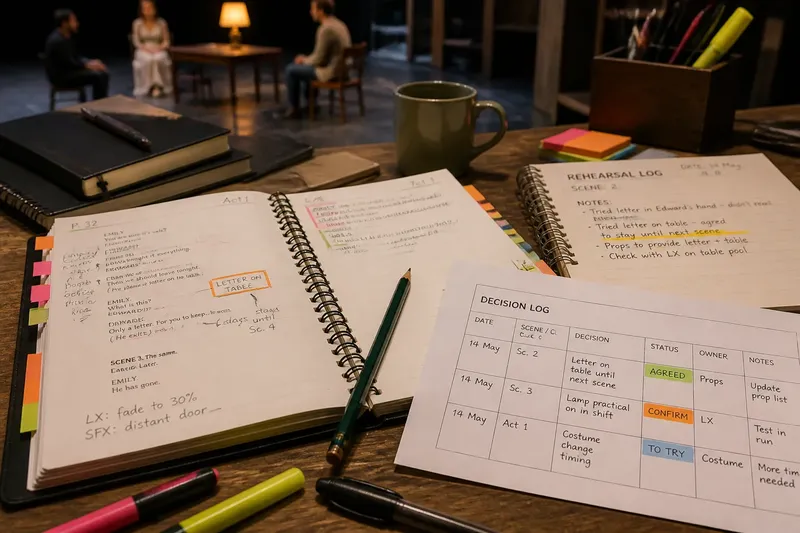
Near the end of the week, review the vocal choices that help the audience follow the scene. Keep notes brief and concrete: which word carries the turn, where the pace needs room, and what level of articulation suits the space. Avoid turning those notes into a fixed recipe. The actor should be able to respond to a different partner’s timing or a changed moment without losing the scene’s shape.
In a run, listen for connection rather than sameness. A line may vary slightly from one performance to another and remain clear because its intention is intact. If a familiar phrase starts to sound automatic, return to the immediate listener and the action the character is pursuing. That often restores the thought without requiring a new vocal mannerism.
Natural-sounding acting on stage is a set of choices, not a single approved sound. Clarity helps the audience receive the words; intention gives those words direction; style places them in the play’s world. When the three work together, a voice can be shaped and still feel alive, because its technique serves the character’s present need rather than calling attention to itself.