Why a Stage Picture Changes When One Actor Moves
Learn to read a stage picture through spacing, sightlines and focus, so a small actor movement can clarify relationships without relying on centre stage.
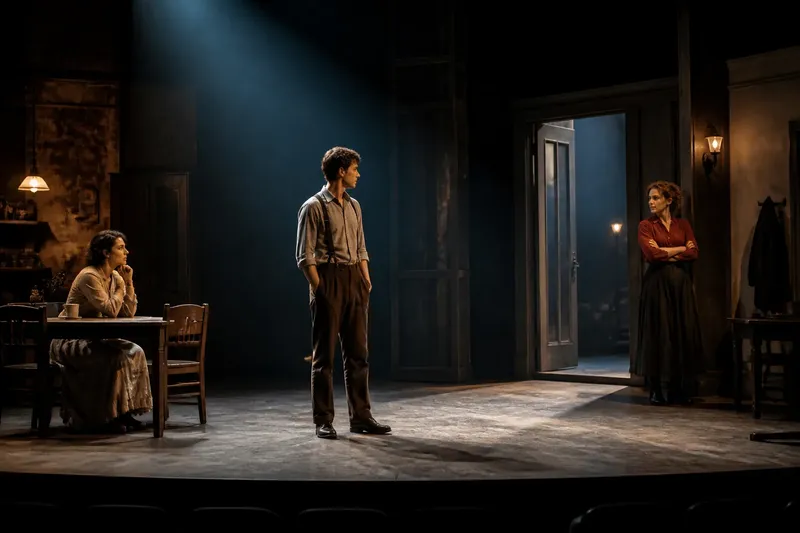
The most common mistake when reading a stage picture is to assume the actor nearest the centre must matter most. That shortcut can hide the real relationship in the scene: a person at the edge may be watching, resisting or being shut out, while the central figure is simply waiting. Read the spacing and relative positions first, and a single movement can change what the audience understands.
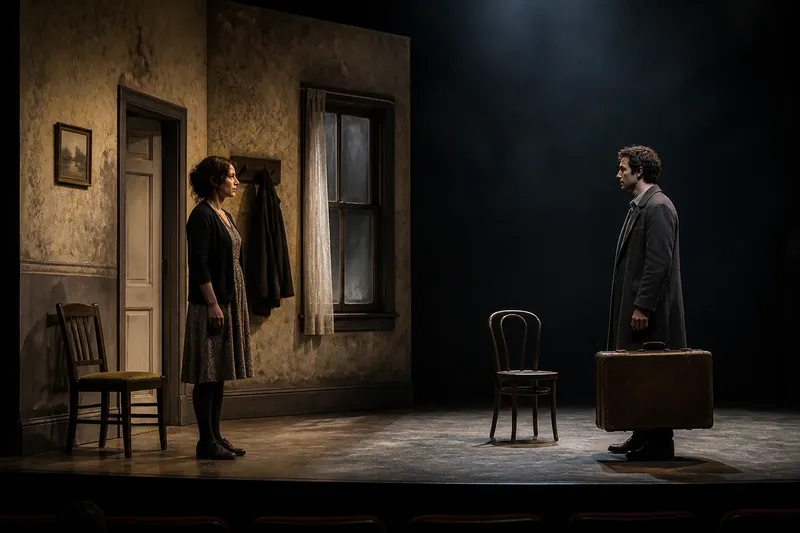
A stage picture is the arrangement of performers and visible space at a particular moment. Directors use it to make relationships legible, but it is not a diagram with one fixed meaning. The audience reads it through distance, direction, grouping, posture and the paths that remain open or blocked. You can learn to read it by looking in a consistent order.
Start with the whole stage, not the centre
Before tracking an individual performer, take in the full playing area. Notice where the actors are clustered, where there is open space, and whether anyone stands apart. Then observe how those areas relate. A gap between two people may feel more significant than the person who occupies the middle of the stage.
Use the audience’s viewpoint. A position that looks central from the wings may not appear central from the front rows, and an actor’s body can hide another performer from some seats. The stage picture is what the audience can actually see, not only what the director sees from the auditorium aisle or the performers feel from within the scene.
Imagine two siblings standing far apart, with a third person between them but turned towards neither. If the third person steps aside, the siblings become visually connected across the space. The move may suggest that a barrier has lifted, even though nobody has spoken and the centre is now empty.
Notice who is close and who has room
Distance is one of the clearest ways a stage picture communicates a relationship. People standing close may seem allied, intimate, crowded or confrontational. The exact reading depends on their faces and bodies, so treat closeness as a clue rather than a verdict.
Look at the space around each actor as well as the space between them. Someone surrounded by a group may appear protected, watched or trapped. A person with a clear route out may seem free to leave; another with bodies on either side may look contained. Ask what the arrangement permits: can the performer approach, withdraw, turn away or pass through?
Now compare the group’s spacing before and after a movement. Has a gap narrowed? Has an actor joined a cluster, or remained just outside it? These changes can shift the audience’s attention from a spoken exchange to an unspoken choice. The useful question is not simply “Who is closest?” but “What has become possible or difficult because of that distance?”
Track the direction of each body
Where an actor faces can reinforce or contradict where they stand. A performer may be physically beside another person but angle their shoulders away. That small turn can make a shared position feel divided. Conversely, someone facing a distant character across the stage can create a strong connection even without moving closer.
Pay attention to eye-line, torso and feet. An actor’s gaze may lead the audience towards a person or object; the torso can reveal whether that attention is open or guarded. Feet often indicate where a performer could move next. When these signals point in different directions, the picture may suggest hesitation or conflict rather than a settled alliance.
Do not assume that facing the audience means a performer is the focus. A person looking out can seem exposed, but the rest of the cast’s attention may make another actor the centre of the dramatic moment. Read the whole pattern of attention: who looks at whom, who avoids looking, and whose movement prompts a response.
Follow the movement and its effect
To understand a change in the picture, compare the moment before the move with the moment after it. Identify the moving actor, the destination and the people whose positions or attention are affected. A move matters when it alters the pattern, not merely because someone has crossed the stage.
Watch for three kinds of change:
- Connection: an actor moves closer to someone, or takes up a position that links two separate people.
- Separation: someone steps away, turns their back or widens a gap that had seemed shared.
- Access: a move opens or closes a route, a sightline or a place within a group.
Say you are watching a rehearsal in which one actor stands between a seated character and the doorway. The actor then takes two paces to one side. The expected observable change is that the seated character can now see the exit and the audience can read the newly open route. Whether that suggests escape, temptation or danger depends on the scene, but the movement has made the choice visible.
Notice the response as well as the move. If another performer shifts their weight, follows the mover with their eyes or claims the space that has been vacated, the picture continues to change. A movement can carry meaning through its consequences, even after the actor has stopped.
Check the sightlines from more than one seat
A stage picture that reads clearly from the director’s chair may be confusing from the side of the auditorium. Bodies overlap; a face disappears behind a shoulder; a gap that looks open from one angle is closed from another. If you are watching a production, compare what you can see with what the arrangement appears to invite you to notice.
From a rehearsal room, a director can check the picture from the centre and from the sides of the audience area. The aim is not to make every seat see an identical image. It is to make sure that essential relationships and actions remain readable. A small adjustment to an actor’s angle may reveal a face without changing the emotional distance between performers.
Also distinguish between a deliberately hidden detail and an accidental obstruction. If a performer is meant to be overlooked, the concealment can carry meaning. If the audience needs to see a reaction and cannot, the arrangement may be working against the scene. The script, performance style and intended audience view help make that judgement.
What should you look for when reading a stage picture?
Does the actor in the centre have the most influence?
Not necessarily. Influence may belong to the person everyone watches, the one controlling an exit or the performer whose stillness changes the group’s behaviour. Compare attention and access before deciding who holds the moment.
What does an empty patch of stage mean?
It can separate characters, provide room for a future entrance or make an absent person feel present. Read the empty space in relation to nearby bodies and the movement that has just created it.
How can a small movement alter a scene?
A step can change a sightline, break a group or bring someone within reach. Look at what becomes visible, who must respond and whether the move changes the available routes through the space.
Can a still actor change the stage picture?
Yes. A still performer can draw attention because others orient towards them, leave space around them or avoid crossing their path. Their position becomes active through its effect on the people who move.
Use a simple sequence when watching or directing
When you want to make sense of a stage picture, follow this sequence without rushing to interpret it:
- Take in the whole arrangement. Locate the performers, clusters, open areas and visible routes.
- Compare the distances. Notice who stands close, who remains apart and who has room to move.
- Read bodies and attention. Check faces, shoulders, feet and eye-lines for agreement or conflict.
- Track one movement. Observe where the actor starts, where they go and which relationships change.
- Check the audience view. Consider whether faces, entrances and significant reactions remain visible.
- Revise your interpretation. Treat the picture as evidence of a relationship, not proof of a single meaning.
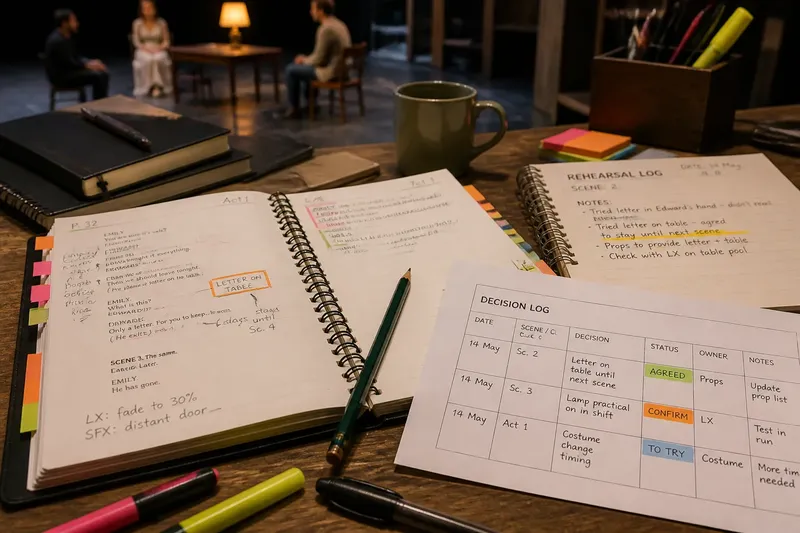
In a rehearsal, this sequence can help a director decide whether a move is doing useful work. If a crossing does not alter attention, access or the relation between performers, it may be unnecessary. If it changes one of those things, ask whether that change supports the moment rather than simply making the stage busier.
It is not worth assigning a fixed meaning to every patch of floor or measuring distances for their own sake. The point is to notice visible differences that an audience can follow. A natural movement may be more persuasive than a carefully symmetrical arrangement if it makes the relationship clear.
Let position clarify the relationship
A stage picture changes when an actor moves because the people around them do not exist in isolation. A step can connect two characters, interrupt a line of sight, expose an exit or make an empty space newly noticeable. Centre stage is only one part of that pattern.
When reading a stage picture, begin with the whole arrangement, then follow distance, direction and consequence. The main search question—why a stage picture changes when one actor moves—has a practical answer: the move alters what the audience can see and how performers relate within the space. In direction, choose movement for that visible effect, and keep the audience’s viewpoint in mind.
Where the right staging depends on the script, performance style or local venue conditions, adapt the arrangement to those needs rather than forcing a single reading. The most useful stage picture is not necessarily the most balanced one; it is the one that lets the audience notice the relationship the scene is asking them to consider.